

THE DANCE OF DEATH 1 💀

In the name of death
In the name of life
And in the name of love
She dances
Kali's Dance
~ Navjyot Kaur Vilain
One of the most underused and underestimated forms of cross training for modern martial artists to improve their skills is that of formal dance, but this historically has not always been the case.
Tacitus mentions how Germanic tribes youths danced naked amongst swords and lances that threatened their lives “Experience gives them skill and skill again gives grace.”
Classical warriors in both Europe and Asia sought to develop the “whole warrior”. One skilled in both courtly and martial affairs (in modern day parlance the concept of the Gentleman Killer). To qualify as a medieval Master At Arms you needed to know at least one dance for footwork.
George Silver the sixteenth century English sword master expressed admiration for Spanish swordsmen “with their feet continually moving, as if they were in dance.”
W E Fairbairn “The greatest of them all” formerly of the Shanghai Municipal Police, who taught both commandos and S.O.E. agents during WW2 recommend learning tap dance for fast footwork.
Antonio Illustrisimo who was probably the deadliest Kali practitioner ever to walk the face of the earth was an excellent cucaracha (cockroach) dancer, he adapted its fast and evasive footwork into his own system.
Bruce Lee was a champion dancer, favouring the cha cha. Drumming was added to his system of Jeet Kune Do, in fact Paul Vanuk used to train West Coast S.E.A.L. teams whilst playing bongo drums (actually drums were used in older Kung Fu systems – traditionally they were fed on blood!).
Seiki Arakaki the karate master said of dance it “softens up” the fighters movements, aiding in the development of yielding and molding actions. Motobu Ryu includes dance as part of its curriculum (many Kobudo kata even had their beginnings as dance).
Doug Cook another karate expert and major in the USMC specialised in dancing shag (a style of jitterbug) which he credited as helping him win two national championships and improving his kata enormously (the Japanese word kata actually means dance).
Masaki Hatsumi the ninjutsu grandmaster noted “The footwork of the tango is similar to that used in Budo” (actually tango footwork is much the same as that mentioned in the infamous 1849 Spanish knife fighting book “Manual Del Baratero”). His teacher grandmaster Takamatsu Sensei was himself highly skilled in Japanese dance.
Steve Benitez the penjak silat master practiced the Indonesian flower dance to explore advanced methods.
T T Liang Tai Chi master (and customs official in Shanghai back in the 1930s when it was considered to be ‘the most dangerous place on earth’), was a championship dancer who mastered the tango, foxtrot, waltz and many others. He put his Tai Chi to music (both solo form and push hands ‘two person dance’) utilising a bung da type of timing – a beat and a half beat which creates sung (being relaxed yet active and alert). His 150 posture Tai Chi Dance is designed to release tension in the muscles and develop chi.
Sonny Umpad the Visayan escrima master was an accomplished social dancer who specialised in the ‘Hustle’ style, winning trophies in regional contests. He would effortlessly glide his partners across the floor reading their body position and footwork which allowed him to anticipate every step or mistep, correcting and compensating for them on an almost psychic level. Growing up in Cebu city barrios he perceived a definite connection between the movements of dancers and the movements of fighters. The Maglalatik ‘Dance of the Coconut Shells’ was the basis for his hand indexing and checking drills, while the Sayaw Moro – Moro supplied toe out low postures for lowline kicking, tripping, sweeping and pivoting. From his dance practice he developed expressive movement with breath taking speed and grace, and learned to change rhythm with the stomp of the foot or clacking of a stick at will without any loss of fluidity. He even composed his own music with which to teach.
Hopefully you will have noticed that all these martial artists of both past and present are considered experts in their chosen field and all benefitted greatly by exploring the realm of dance.
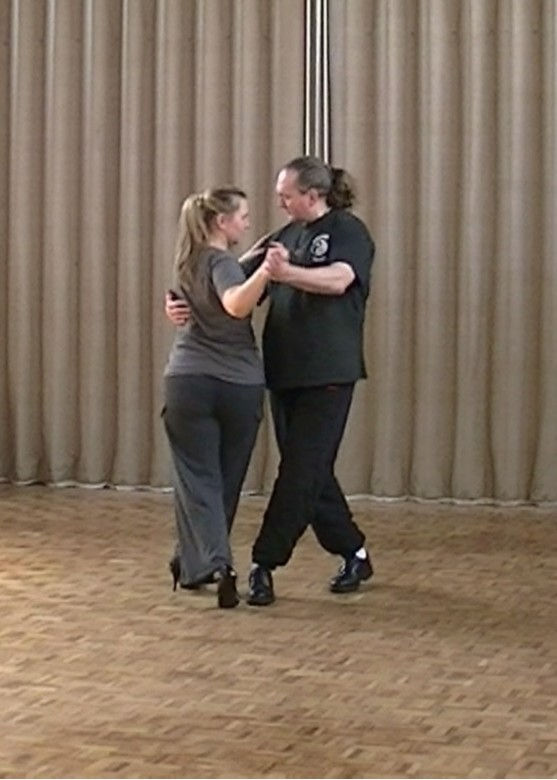
I guess before I go any further I should quickly run through my own personal dance journey. Firstly I freely admit I am not a natural dancer and have no musical talent whatsoever.
Like most fifty somethings plus my first foray into formal dance was mandatory country dancing back in primary school, an experience most of us can only recollect under hypnotic regression as traumatic in the extreme (a quick shout out to my former dance partner in crime Elaine Pennington who is unlikely ever to read this, but on the off chance – “I am so sorry for my complete and utter podal ineptitude gorgeous I can only hope sometime over the last forty five years you’ve managed to forgive me”), and dancing around the Maypole (I messed up every single time) which should really be legally classified as some form of abuse or other!
Needless to say I didn’t go near formal dance again for a very long time...until. Natalie and I discovered that we had something in common, the film ‘Naked Tango’ had influenced us both in our teenage years, and we had always wanted to learn the dance.
So after familiarising ourselves with the basics via ‘Tango City’ on YouTube we took our first tentative steps into ballroom tango with the always fun Phil Hurst (it’s basically like learning short forms), which then led us to Argentine tango down at Tango Cheshire which was a whole new ballgame (think more pushing hands skills) Mike and Leonda are true masters of their craft and we had the privilege of training with the best guest instructors Argentina has to offer!
(It’s at this point I feel I should mention between the two of us Natalie is the better dancer by far, she has natural rhythm, is musically minded and has a lot more training and experience than myself and also retains kinesthetic information way better than I do – I’m basically lost without my class notes.)

With my new found dance confidence I went on train in capoeira with instructor Ken at Danca Da Liberdade Capoeira and even turned my hand (and everything else) to Egyptian Sufi dance under the Dervish Sharif Abrihim (a world record spinning holder).
By now it had become apparent that I have absolutely no concept of musical ‘beat’, some don’t and it really isn’t an issue for us...unless we have to dance with someone who does, evidently we upset them A LOT (my advice, stick to your own kind and you can still dance perfectly well, even if to the bemusement of others).
So at least trying to get a handle on this I decided to take up an instrument for the first time – school doesn’t count, I dropped music in third year options like a hot brick and never looked back, and no I really couldn’t play the tortuous glockenspiel even after three years, imagine a palsy victim trying to perform brain surgery with a cricket bat and you’ll get the idea.

I decided to go right back to the source and tackle Senegalese drumming using the Djembe and Sabar under the tuition of master drummer Karim Mbaye, loved it – the man just wants you to learn and be happy. This in turn led me to try using the Arabic Darbuka with Simona Abdallah – beautiful, talented and so patient (a trait you definitely need when teaching me).
Fun but to no avail, I’m afraid ‘beat’ and myself will always be strange bedfellows...and after all that I then found out that it’s actually acceptable (though less common) to dance to the rhythm instead of the beat during a tanda! For crying out loud.
So to quote master Chungliang Al Huang “Enough with the talking get on with the dancing”.
Mathew Birchall


*Image sourced from Canva.
**Images from personal collection.


Comments